This is the first of a series of probably four posts about the restoration of a Tripet MHP 500 surface grinder. The series came together a bit on the fly so the writeup is lagging behind the actual work. Everything shown here is already done and the machine is up and running.
An overview page for the series lives here: /projects/tripet-mhp-500/.
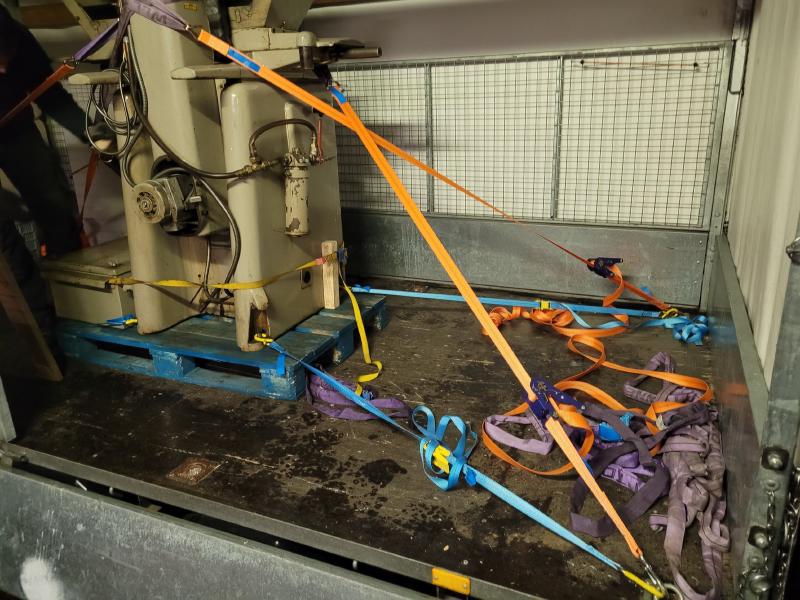
A blind buy, late on a weekday evening#
The whole thing was a bit of a surprise. A friend pointed me at a used surface grinder listed on Tutti (the Swiss equivalent of Craigslist) - a Tripet MHP 500 - and to be honest I didn’t really have Tripet on my radar. I read up on it that same evening, liked what I found (compact, Swiss-built, reputation for being very accurate), the price was good, and so I bought it unseen.
The machine had to leave the seller’s shop urgently and my holiday was coming up, so I had exactly one evening to organise a trailer and fetch it. My workshop landlord - who seems to have a solution for every problem - lent me a nice three-axle trailer with a canopy. The canopy turned out to be quite useful: the drizzle that started halfway there didn’t get anywhere near the machine.
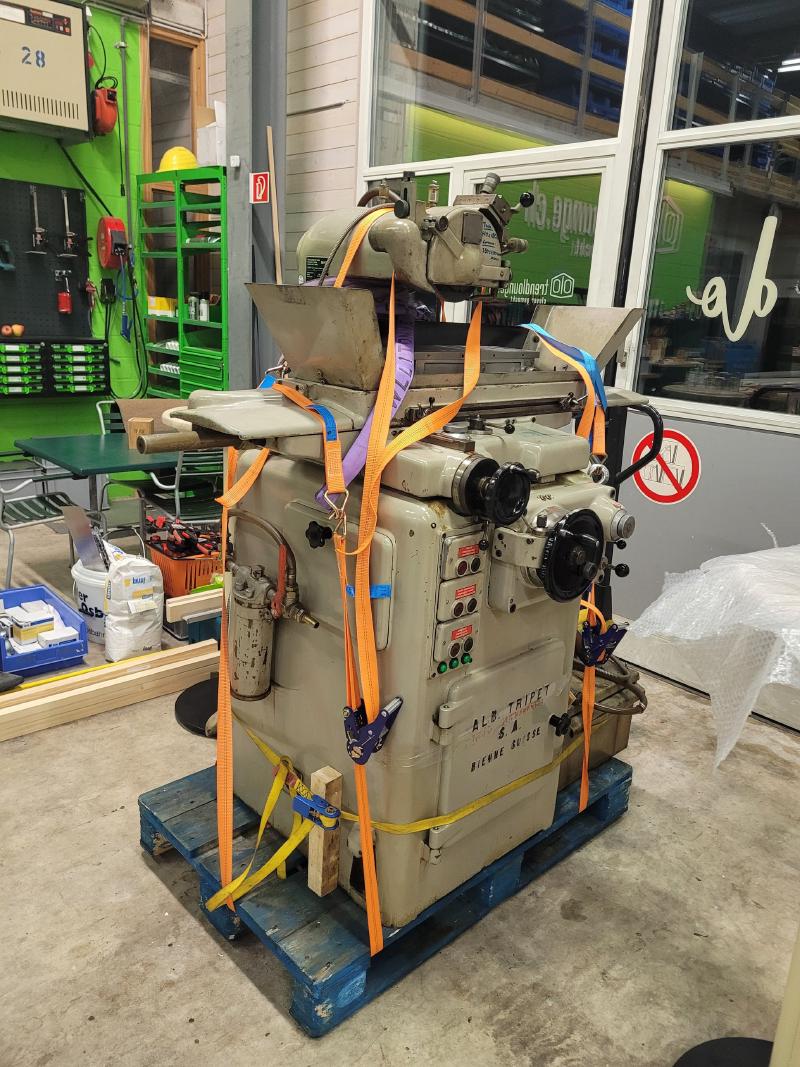
I got the Tripet loaded onto the trailer with a forklift, tied it down properly and drove the hour back home. Unloaded it with the forklift again, after strapping everything tight to the pallet so nothing could shift. Just before midnight the grinder was standing in a dry, heated hall - but still parked outside the actual workshop, because it was slightly too wide to go through the door. It stayed there for about two weeks while I was away.
The machine#
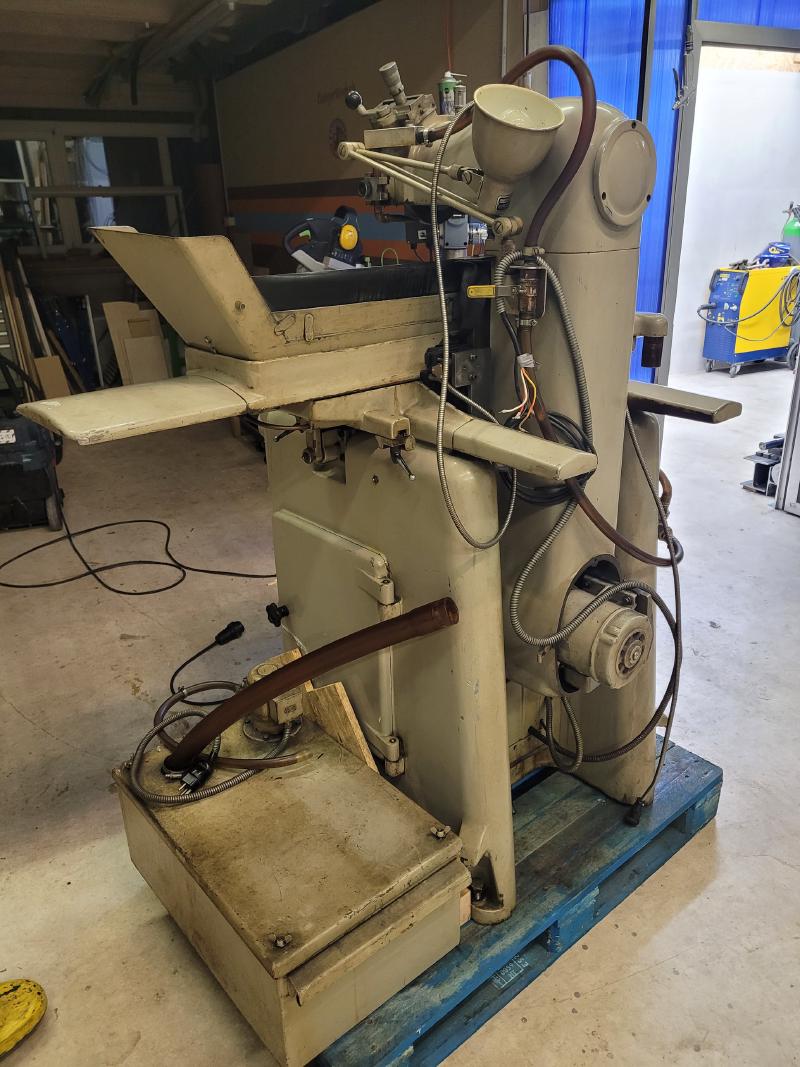
The Tripet MHP 500 is a Swiss surface grinder from the 1960s. Mine was built in 1963. The key numbers:
- Travel: 500 × 180 mm in X and Y, roughly 300 mm in Z
- Footprint: 1050 × 1950 mm including the full pendulum stroke
- Mass: about 1200 kg
- Coolant unit: separate, tucked underneath the pendulum table in operation
It’s remarkably compact for the size of work it can do. The coolant unit is a separate piece sitting on a pallet to the right in the first photo - it actually belongs on the left side of the machine.
Documentation-wise I got lucky. The machine originally lived in the Werkzeugmaschinen-Laboratorium of ETH Zürich. It was bought new by ETH in 1963 and stayed there until just before Christmas. From there it took a short trip to Canton Berne where it was never plugged in or even lifted off its pallet, and then, two weeks before I wrote the first forum post, came to me. The paperwork survived all of that, including the original purchase record.
What came with it#
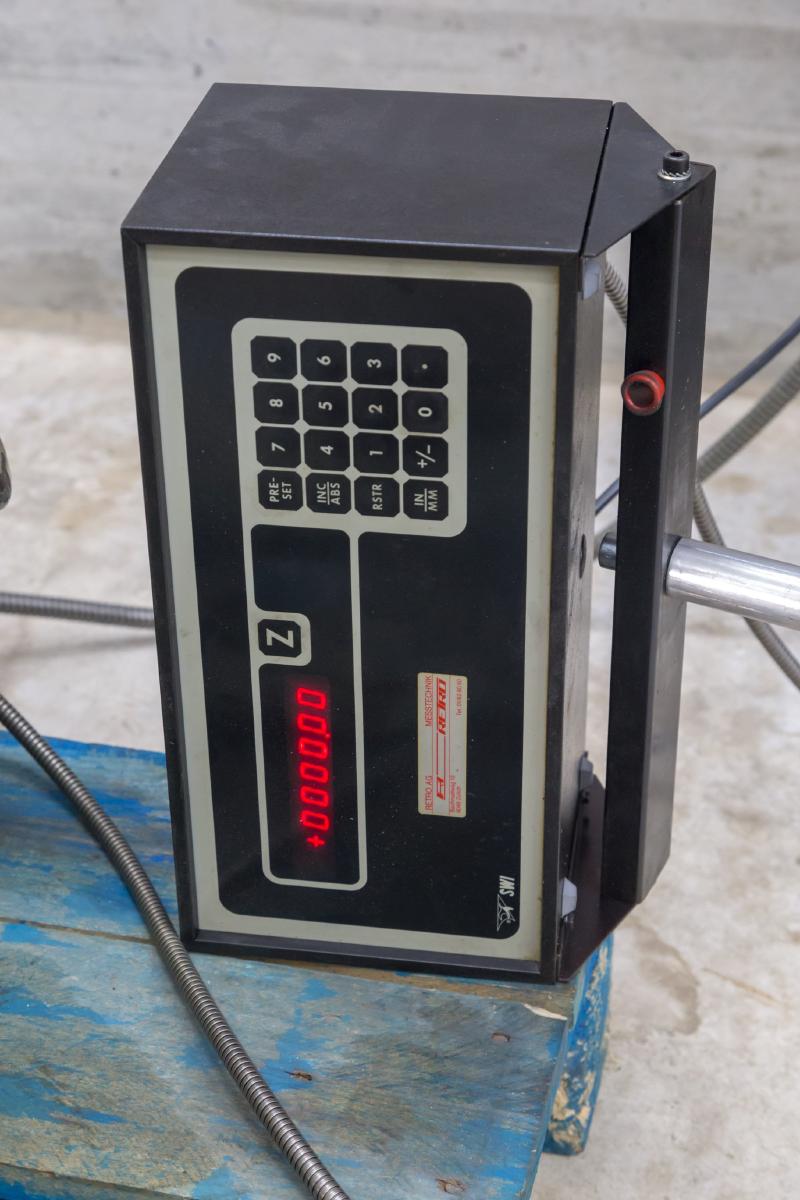
A decent pile of accessories was included: seven flanges (the wheels themselves are mostly well used), magnetic parallels, balancing arbors, a Wyler balancing rig, and an ancient one-axis DRO.
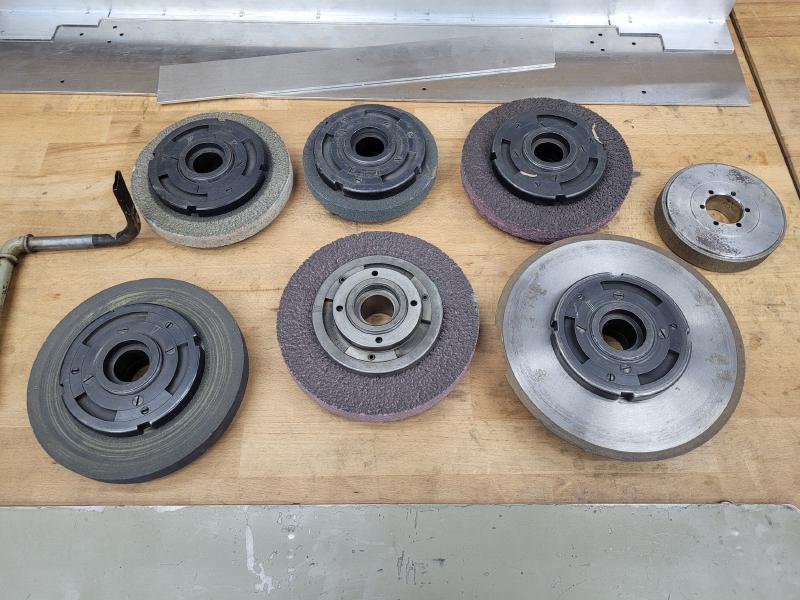
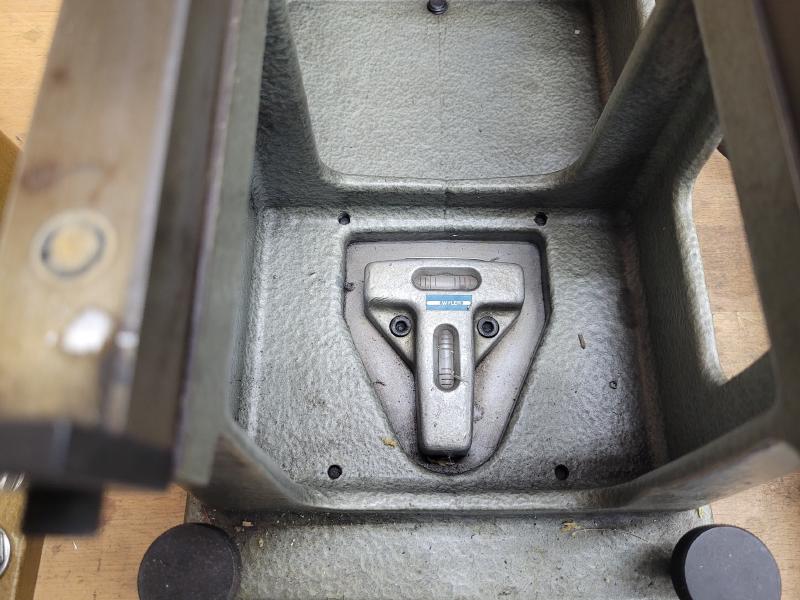
The balancing rig was probably the thing I was happiest about. I’ve been improvising balancing for my Tschudin cylindrical grinder and for the Schaublin’s dividing head, and now I finally have a proper tool for it.
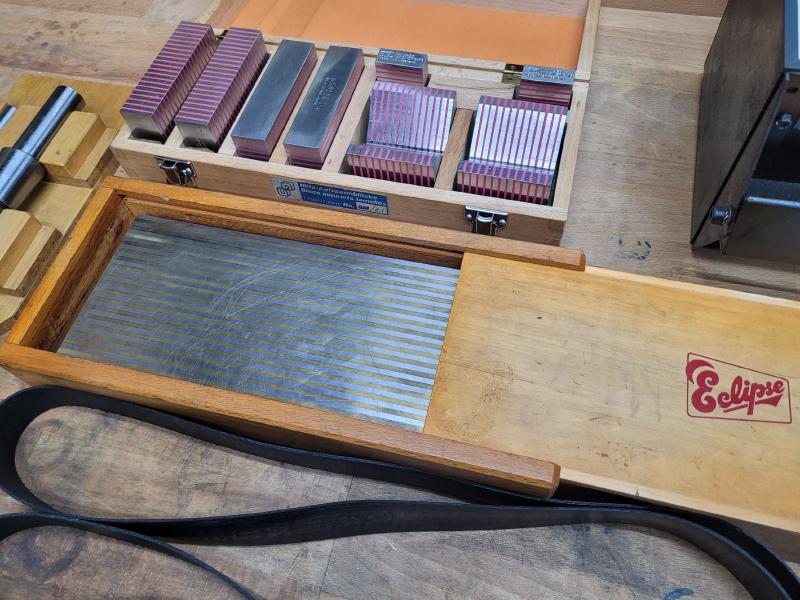
The magnetic parallels are a nice set, also Swiss-made except for the big Eclipse block.
The diamond dresser at the head has an exotic taper, roughly MK0 in diameter but something like a 1:25 taper ratio, so replacement diamonds will have to be ground to fit.
Moving in and first power-on#
Two weeks later I was back. Getting the machine into the workshop meant tearing down part of a light stud wall (and putting it back up afterwards), same routine as when the Tschudin moved in.
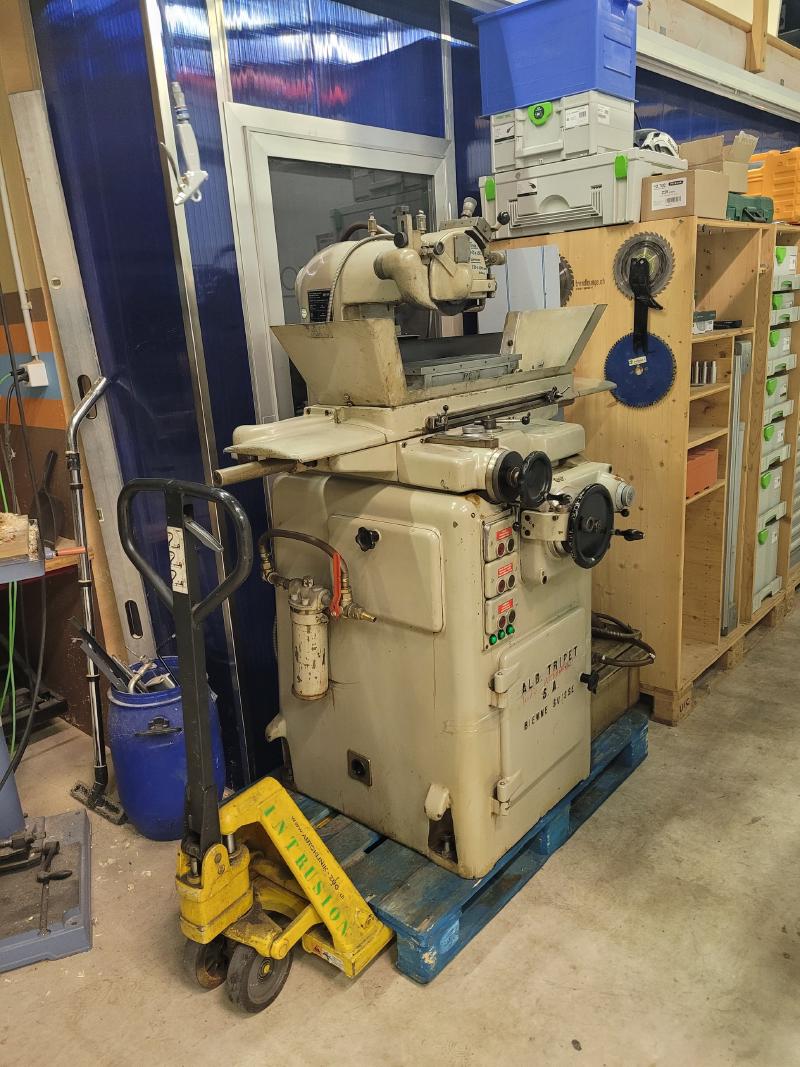
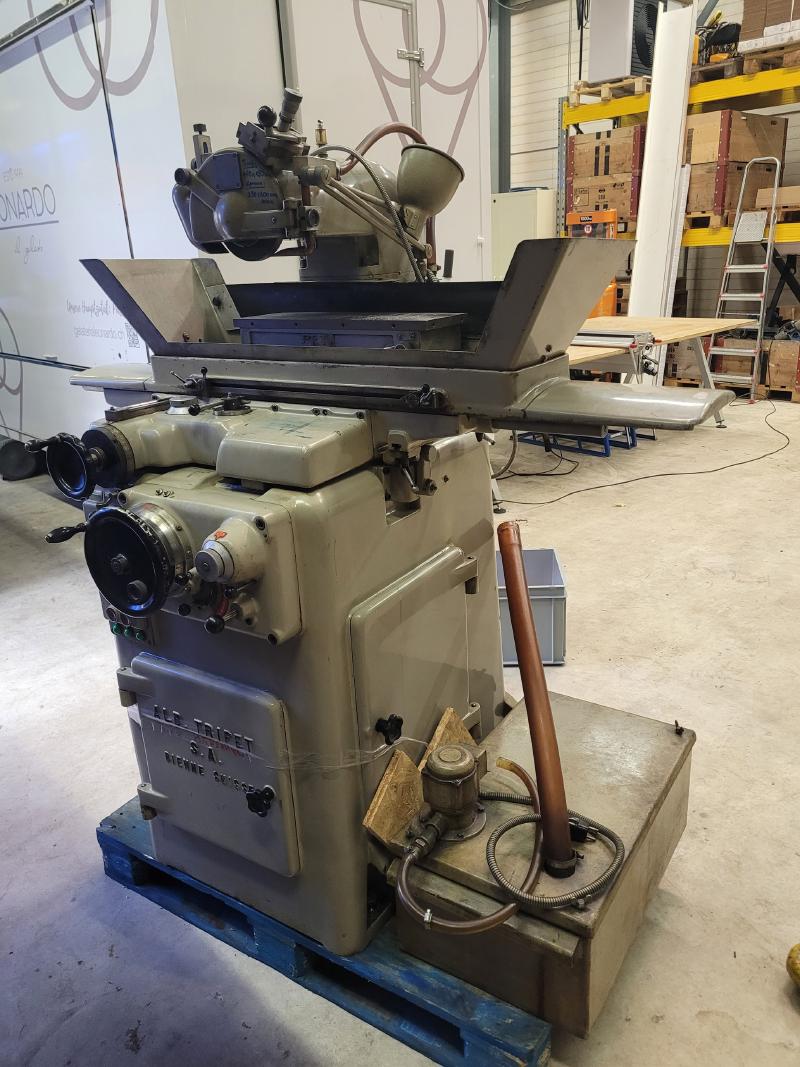
There was no plug on the cable, so first I fitted a modern one. The wire colours were, of course, straight out of 1963. The right oil was in the cabinet already, so I filled the reservoirs and flicked the hydraulic switch.
The lights went out.
The RCD had tripped. Unplugged the hydraulic motor, measured it - perfectly healthy. But one phase, measured at the switch with the motor disconnected, showed about 600 Ω to ground, more than enough to kick the RCD. It was already past midnight, so I left it there for the night.
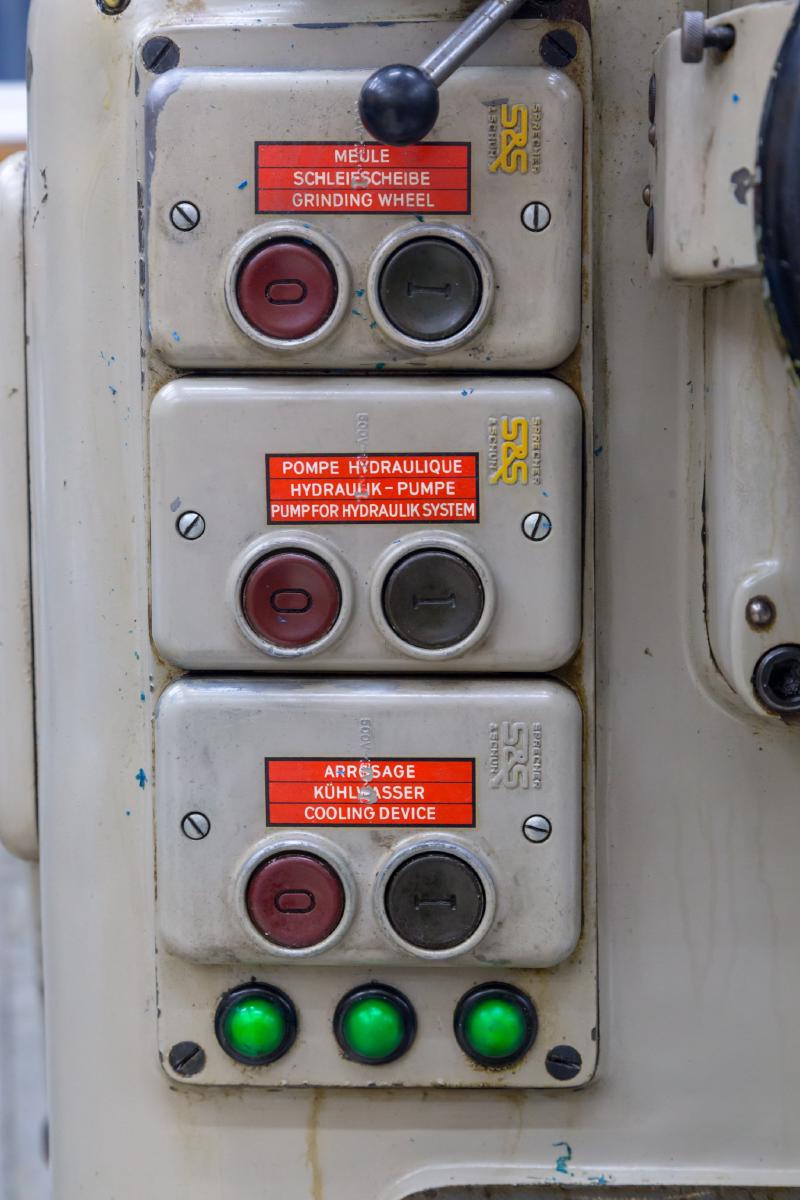
This is one of the nicer things about a 1963 machine: there is no electrical cabinet, no contactors, not even a relay. Just three big Sprecher+Schuh switches, one per motor, with a lamp next to each. The whole wiring diagram fits on a Post-it. Troubleshooting shouldn’t take long.
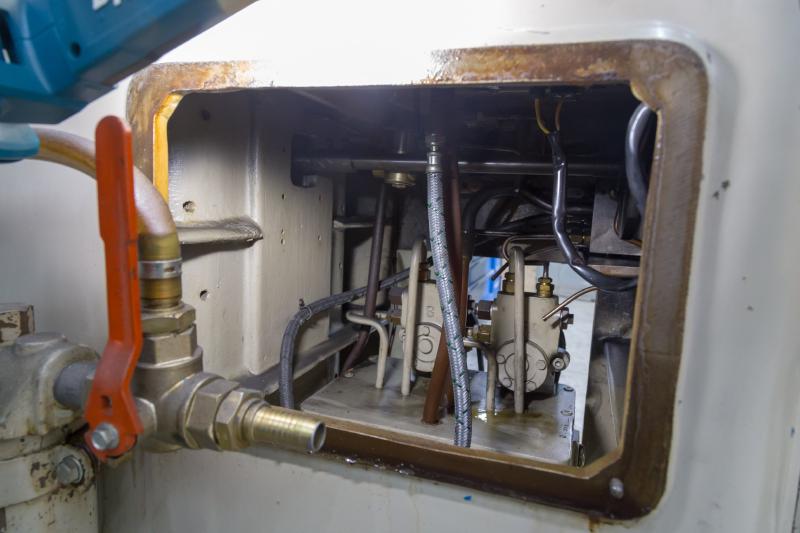
With the covers off I was pleasantly surprised. The insulation was still soft, nothing was crusty, and the general grime level was well below what I’d expected from a 62-year-old machine. The spindle turned smoothly after I put some tension back on the flat belt, the taper looked almost unused, and all the obvious premium options were there: micro-feed in Z, automatic Z-feed in 5 µm increments, and a fine cross positioning spindle. All the oils specified in the manual - Velocite No. 6, a 68-weight slideway oil, and DTE Oil Light - are things I happen to keep in stock for other machines anyway.
Now I just had to find out what that 600 Ω was doing on one phase, get the spindle and hydraulics running, and see what the thing could do.
Continue to Part 2: Electrics, Spindle Rebuild and First Sparks.