Recent
Ultrasonic Anemometer
This page serves as a directory of all my posts and downloads related to my Arduino based Ultrasonic Anemometer.
First Attempt with an ArduinoUno and two separate boards
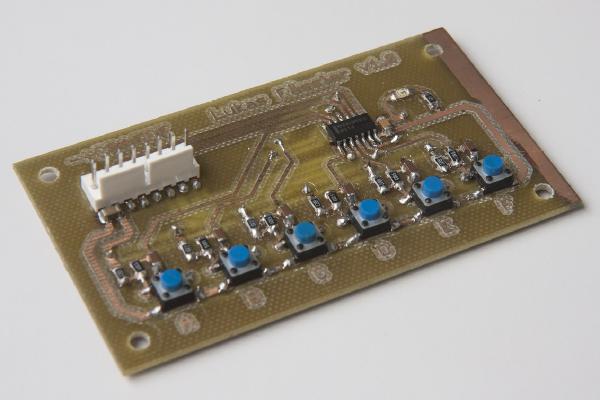
Switch debouncing using 74HC14
This was one of the first PCBs I ever made myself as well my very first attempt at soldering SMD components. So if you were wondering why some of the copper on the right has not been removed - that’s why. At that time, I was not even using Eagle yet but some software called Sprint Layout. But this post is not really about this unimpressing board but about proper debouncing. Something I feel strongly about ;-)
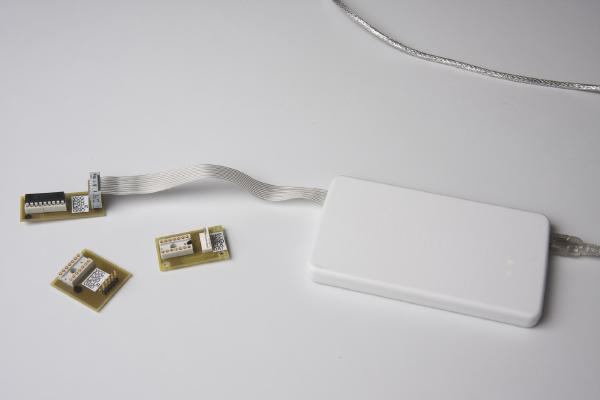
Programming sockets for PIC microcontrollers
I regularly use PIC microcontrollers. I’ve tried some Atmel chips lately but I’m still by far most familiar with the PIC16 & PIC18 chip families. As you can see in my other posts, I tend to use SMD components but once in a while I need to program a DIP package.
About me
My name’s Lukas. All my life I’ve been fascinated by anything technical and electronics in particular. With some help from my dad I soldered blinking lights and morse keys by the age of 12. Later, as a teenager, I got my ham radio license but have never done much with it. I guess I find tweeking circuits more fun than being on air.
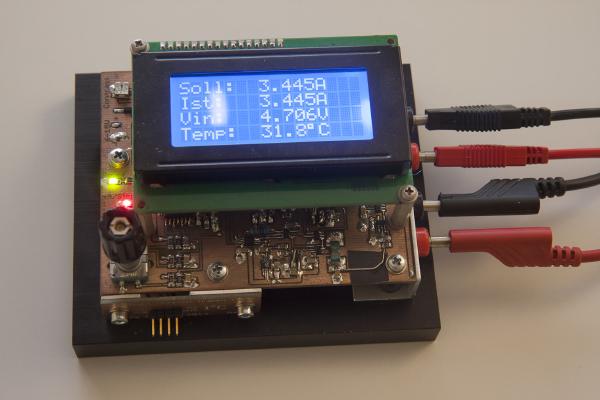
Constant Current Dummy Load
This is a constant current dummy load. It’s controlled by a PIC16F1936 microcontroller. As you can see, it’s equipped with a 4x16 character LCD display and, less obvious, a rotary encoder with push button. It accurately sets the desired current via a 16bit DAC and reads both current and input voltage with a single-channel 16bit ADC each. Temperature is measured by the microcontroller’s internal 10bit ADC.
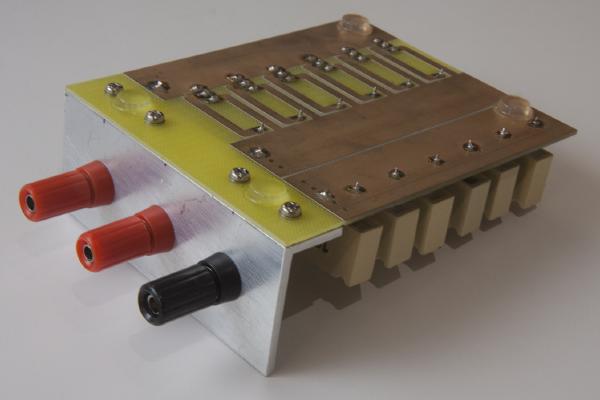
Simple, resistor based Dummy Load
Another afternoon project. Some time ago I was working on a 80 watts 12-to-36 Volts DC-DC boost converter. Not one of my most successful projects but anyway.
So I needed some kind of load but my home made constant current dummy load can only handle 20-something volts. A few 100 ohms 15 watt resistors were just what I needed. So I took 6 of them and made a simple, single-sided PCB that holds the resistors as well as 6 switches.
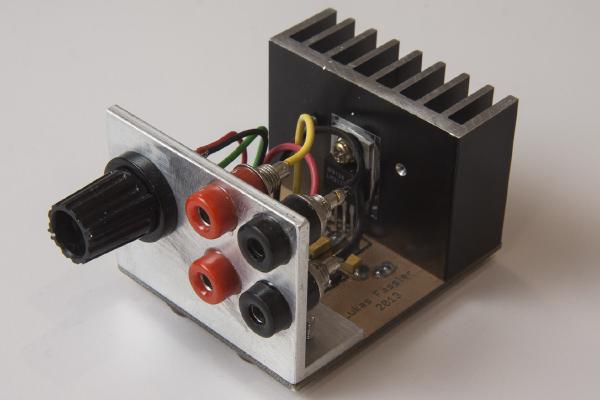
Variable Voltage Power Supply using a LM317
A classic afternoon project. I was in need of a variable voltage and didn’t have a proper lab power supply available. But I did have a solid 12 volts from an old computer PSU. So I built myself this little thing.
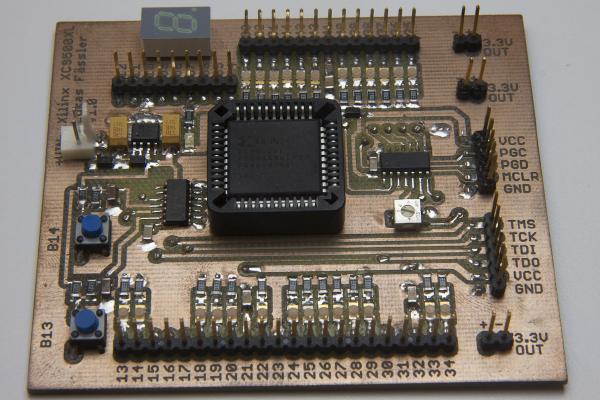
Xilinx Prototyping Board
Some time ago I wanted to try out programming CPLDs in VHDL. I was entirely new to both of those topics and I didn’t have a real need for a CPLD at the time. So I built myself a nice little prototyping board for the Xilinx XC9500XL complete with some push buttons, LEDs a 7-segment display and a PIC16F688 used mainly as a clock source.